
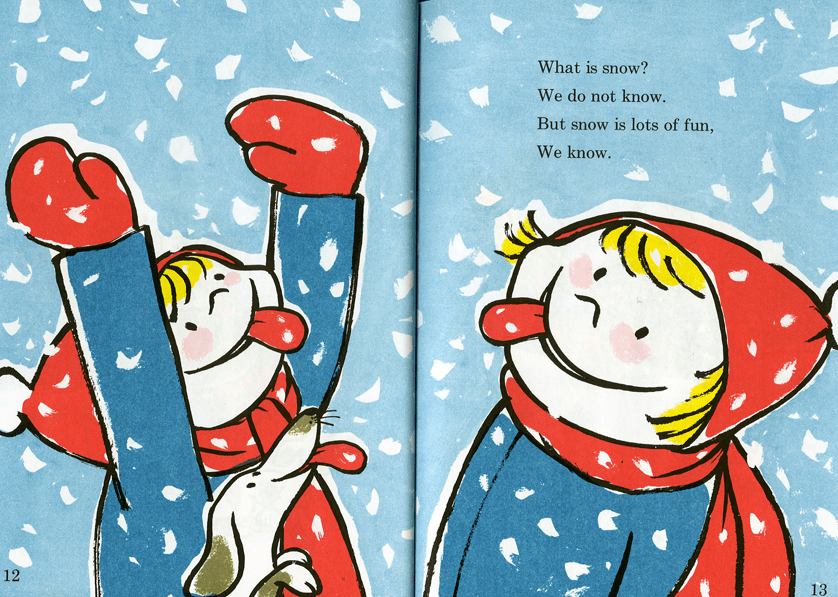
The image above comes from P.D. Eastman’s Snow, which was one of my favorite winter books as a child. You may have read it too, and when you were older, you may have read it to your children. Adults tend to think of snow events as something to prepare for (as they should), but children look at snow with a sense of wonder. Some of us remember listening to the radio, hoping that our school name would be read in alphabetical order and we’d end up with a precious snow day: a day to make snowmen, snow angels and snow forts, to have snowball fights, to go sledding. If we were fortunate, someone else shoveled the driveway, but if it was us, we earned our fun and our hot cocoa!
We have a choice on how to regard a winter storm: it can be frightening and anxiety-producing, or an opportunity to reflect. Christian composers Jonathan and Melissa Helser have a wonderful take on “The Necessity of Seasons” ~ I won’t spoil it for you because it’s so beautiful. Watch the video below!
Now let’s add some snow! Here are Jonathan and Melissa on their back porch in North Carolina, singing a song about the winter as the precipitation falls and their breath makes tiny clouds.
Do we have the faith to sing winter? It’s all a matter of perspective. Last winter our book group read Kari Leibowitz’ How to Winter, which recognizes the fact that seasonal affective disorder peaks at this time of year. Some have even pinpointed a date: the third Monday in January (but sometimes the fourth), meaning right about now. The reasons include a post-holiday letdown, bills coming due and a feeling of isolation caused by cold weather and winter storms. If you haven’t yet read this book, it’s a great time to do so. Or try Katherine May’s Wintering: The Power of Rest and Retreat in Difficult Times; or if you’re looking for something more fun, Sally Coulthard’s The Little Book of Snow.
Scripture contains at least 25 references to snow, the most famous being “though your sins be as red as scarlet, they shall be as white as snow” (Isaiah 1:18). Snow is a metaphor for purity; as it blankets the landscape, imperfections are covered, terrains smoothed. Falling snow cleans the air; snow on the ground protects fresh growth below. For all the talk of fallen limbs and power outages, there is an equal and perhaps even more powerful set of positive effects. In the wake of his greatest transgression, David writes, “Wash me, and I will be whiter than snow;” he yearns for the Lord’s intervention, trusting that God has the power and the will to wash him clean.
The perfect hymn for today is Christina Rossetti’s “In the Bleak Midwinter,” originally written as a poem; while it’s technically a Christmas-to-Epiphany hymn, the first verse is just like today’s weather. Here’s a short version by for KING & COUNTRY that contains only that first verse:
In like manner, the 37th chapter of Job contains a glorious passage about snow and ice that matches today’s forecast:
God thunders wondrously with his voice;
he does great things which we cannot comprehend.
For to the snow he says, ‘Fall on the earth’;
and to the shower and the rain, ‘Be strong.’
He seals up the hand of every man,
that all men may know his work.
Then the beasts go into their lairs,
and remain in their dens.
From its chamber comes the whirlwind,
and cold from the scattering winds.
By the breath of God ice is given,
and the broad waters are frozen fast.
He loads the thick cloud with moisture;
the clouds scatter his lightning.
They turn round and round by his guidance,
to accomplish all that he commands them
on the face of the habitable world.
Whether for correction, or for his land,
or for love, he causes it to happen.
The passage encapsulates both the terror and the wonder of a winter storm. What can seem benign to those who are safe and warm, larders stocked, generators charged, can seem threatening and intimidating to those who are not prepared or who are caught off guard. Already today, the storm has left tens of thousands without power in areas unaccustomed to an overload of snow and ice. The peculiar last line of the Scripture sums up a myriad of feelings: “whether for correction, or for his land, or for love, he causes it to happen.” This is the Revised Standard Version; the New International is even more direct: “He brings the clouds to punish people, or to water his earth and show his love.” Like many things in life, it’s all a matter of perspective; a snow day provides an opportunity to reflect.
Here’s a lovely Christmas song that doesn’t mention Christmas, which makes it perfect for a winter playlist. Chris Tomlin and Audrey Assad sing that the Lord “came like a winter snow, quiet and soft and slow, falling from the sky in the night to the earth below.”
Eventually, the storm will pass; the cleanup will begin. This reassurance lies at the heart of the 147th Psalm: He sends his command to the earth; his word runs swiftly. He spreads the snow like wool and scatters the frost like ashes. He hurls down his hail like pebbles. Who can withstand his icy blast? He sends his word and melts them; he stirs up his breezes, and the waters flow. The sun will come out tomorrow; if not tomorrow, then the next day. Hopefully by then we will all be able to say that we survived the winter storm, and if we can survive something so vast and fierce, what else might we be able to endure? If God can melt the snow, might God be able to melt a frozen heart, or clear a pathway to grace?
When the storm ends, look outside to see the skies clearing, the birds and squirrels foraging, the children playing, as the howl turns to a hush and finally to a happy purr. We wish the same for you: the blessing of safety, the promise of the returning sun, the wonder of a world transformed. May the same God who brings the storm be our shelter from the storm, and lead us to brighter days once the danger has passed. Amen.
P.S. Watch this video ~ it will make you SO HAPPY!
 Centerport United Methodist Church