Call to Worship
In returning and rest you shall be saved;
In quietness and trust shall be your strength.
Unison Prayer
O Lord our God,
Teach us to live in your Spirit.
Help us to walk in your footsteps.
Lead us in pillars of fire and cloud. Amen.
Words of Assurance: Psalm 107:35, adapted
God changes deserts into pools of water and dry land into flowing springs.
The Lord’s Prayer
Our Father,
who art in heaven,
hallowed be thy name.
Thy kingdom come,
thy will be done,
on earth as it is in heaven.
Give us this day our daily bread;
and forgive us our trespasses,
as we forgive those who trespass against us.
And lead us not into temptation,
but deliver us from evil;
for thine is the kingdom,
and the power,
and the glory forever.
Amen.
Opening Song: Lauren Daigle, “Rescue”
Scripture: Isaiah 35:1-4, NIV abb.
The desert and the parched land will be glad;
the wilderness will rejoice and blossom.
Like the crocus, it will burst into bloom;
it will rejoice greatly and shout for joy.
The glory of Lebanon will be given to it,
the splendor of Carmel and Sharon;
they will see the glory of the Lord,
the splendor of our God.
Strengthen the feeble hands,
steady the knees that give way;
say to those with fearful hearts,
“Be strong, do not fear;
your God will come.
Sunday Sermon
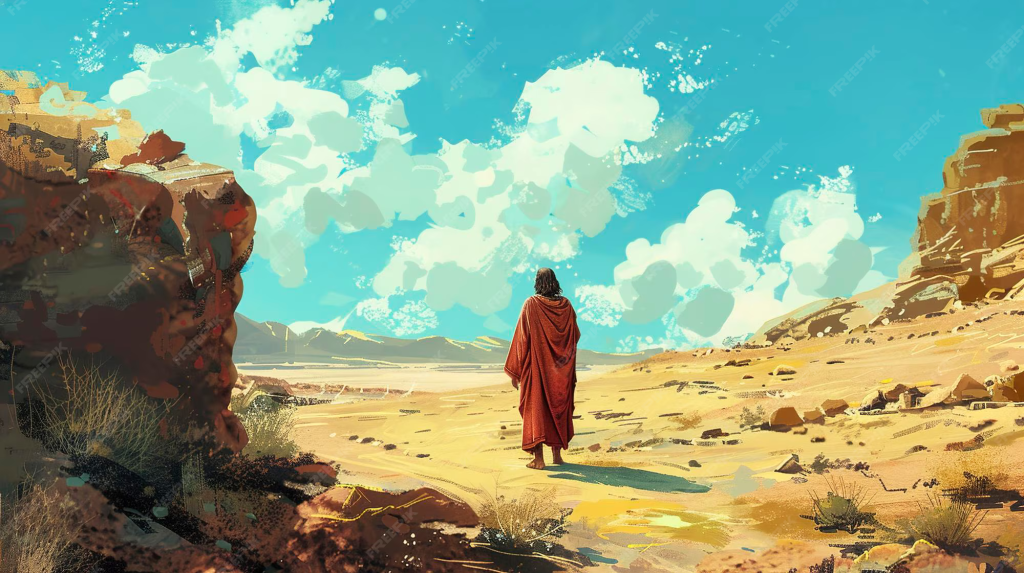
At the beginning of Lent, Jesus went into the desert. He didn’t bring a cellphone, a laptop, an iPad, an Apple Watch, a Playstation, a book or a magazine. He didn’t bring luggage, a change of clothes, a toiletry bag, his wallet, keys or ID. He didn’t bring a car, a bicycle, a skateboard, a tent, a blanket or a pillow; no hunting equipment, no fishing gear, not even a snack. Jesus did not pack like we would pack; and yet somehow, he survived one day longer than anyone on “Survivor,” and without help of any kind, except from God. Even more miraculously, he came out stronger than he entered.
In the Christian church, Lent always begins in winter and ends in spring. It can be as early as March 22 and as late as April 25. So it matches up well with the idea of emerging from winter, from the wilderness, from a desert place. We are supposed to start in a place of need and end in a place of abundance, using this time, as Jesus did, to get closer to God. We’re about a third of the way through – we should be at halftime, but the Catholics for made Lent six days longer so we could suffer more, and we still have four weeks to go.
But this week we have a special gift. Let’s call it a preview: four days of mid-spring weather, beginning today, with a forecast of 60 degrees tomorrow. It’s a promise that spring is coming, that the snow will melt, that things will get better. And we need it; it’s been a long, cold, snowy winter, and the news cycle has done little to cheer us up. People want to get outdoors again; but even more, they want to hope again.
So let’s review the type of world Jesus left behind when he went into the desert. There was an evil king who did whatever he wanted, and the king’s advisors existed only to please him. If someone stoke against the king, that person was arrested or killed. There was a great divide between the rich and the poor, and the poor had no rights or recourse to the law, because the justice system was corrupt. Women and children had no rights, and those who were poor were said to deserve their poverty. Prejudice was rampant; foreigners and immigrants were especially suspect. Misinformation was presented as fact. People had so much to deal with in their lives, from unemployment to disease to war, that they were filled with anxiety. They welcomed any type of distraction, so they drowned themselves in entertainment if they could and always wanted to talk about “the latest thing.”
So when the Spirit led Jesus into the desert, the Spirit wasn’t only leading Jesus toward something, but leading Jesus away from something else. We think of this desert as a vast and lonely place, which it was, but we also look at it as a terrible place, because it’s not someplace we’d like to go, except maybe for a short visit and definitely with a guide and with our cellphones charged. But here are two things we don’t understand: number one, we’re already in the desert; and number two, we’re in the wrong desert.
So what desert are we in? We are in the desert of despair, the desert of distraction, the desert of doubt. Jesus was in the desert of solitude, the desert of silence, the desert of spareness. Jesus left behind the desert we’re in to go to a different desert. Stripped of all distractions, he was left alone with his thoughts, with nature and with God. Mark tells the whole story in two sentences: “he was in the wilderness forty days, being tempted by Satan. He was with the wild animals, and angels attended him.” In Mark’s version, Satan is there the whole time, not just at the end; but so are the angels.
It is impossible for me to write this sermon without mentioning Karim, who spoke to us last week. Karim was in a desert of his own for nine months. We thought of this as a nightmare: three seasons spent entirely indoors, with no freedom, no privacy, and no hope. But last week, we met a different person that we expected: a person who seemed to have grown stronger from the experience, who found his purpose, who grew where he was planted, who relied on God and was rewarded with blessings internal and external.
If you’re like me, you have been saying to yourself, “I would like some of that in my own life: some of that clarity, some of that gratitude, some of that faith.” There is a way to do it, and Lent is the right time to do it: we have to get to the right desert.
We’re used to thinking of a desert as a place where things are not, instead of a place where things are. Jesus learned that the desert is a place where things are: a bounty, rather than a void; a positive place, rather than a negative one. But what one can’t find in the desert are unnecessary things. Life is stripped down to its basic elements. Those who live there are efficient; they learn how to survive and even to thrive. Jesus certainly noticed the wolves, jackrabbits, lizards, hawks, beetles and bees, because later he would preach, “Don’t worry about what you will eat or what you will wear; God feeds the birds and clothes the flowers. Don’t worry about tomorrow, because tomorrow will have enough worries of its own.” He taught his disciples to pray, “Give us this day our daily bread,” knowing that each day God would provide, but that God’s blessings were renewed each morning. He probably spent each day by a stream, remembering the 23rd Psalm: for him, a stream of life-giving water.
The closest experience I had to Jesus’ time in the desert was the eight days I spent in Kenya, deep in the wilderness, visiting a friend in the Peace Corps. There were dangerous animals just outside the village, and no fences. We had to boil everything we drank. There was malaria there, and cholera, and tuberculosis. Everyone was poor. I didn’t eat much there, because there wasn’t much to eat: vegetables and the occasional banana, although one villager said that he was honored by my visit and offered to kill a skinny dog. I told him I wasn’t that hungry, and it was true. In fact, I realized that I needed a lot less than I thought I did. It only took me eight days to go native; my electric razor stopped working, and I started sleeping when the sun went down and rising when it came up. What I did need, apart from God, were the people there who took me in and who showed me how a community could be happy by relying on each other: by sharing the little food they had, watching over the sick, by tying plastic bags together until they had enough to make a soccer ball. I learned that everything I own is a luxury. To this day, I try to lead an uncluttered life.
The desert seems to be a scary place, until we redefine it. The desert we’re in is a desert of fear and uncertainty. The desert Jesus entered was one of prayer and provision. The desert we’re in is one where every spare minute is filled with worldly things; the desert Jesus entered offered abundant time with God. The desert we’re in saps our energy and our hope. The desert Jesus entered increased his strength and resolve. Which then is the real desert?
In her book, The Beginning Comes After the End, Rebecca Solnit makes the case that everything we’re going through is not evidence that the world is getting worse on its way to eventual destruction; instead, it’s the last gasp of the old world trying to hold on, fighting like a cornered animal. She reminds me that in our lifetimes (or at least in mine), things have drastically improved for women, for people of color, and for the poor; that less of the world is at war and that fewer are dying of disease. In America, violent crime has drastically decreased. And yet, we are more anxious and afraid and uncertain than ever before.
We could blame the usual suspects: cellphones and social media. But each of these is only a tool. The real culprit is where we put our attention. If we focus on what is bad, and especially what is bad in the short term, we lose our way. We start to think that everything is getting worse and that things have never been as bad as they are. But we’re wrong, and almost every metric shows it.
One of the things I know, but don’t understand, is how the baby squirrels I see on my lawn survived the winter. They were born when it was cold and there was already snow on the ground; and then more snow fell, and it was below freezing for weeks. And then it got worse, and a foot and a half of snow fell on the other snow. Where did they get food? Did their parents store nuts in the trees? I can tell you this: I’m sure those squirrels thought life was hard and it was only getting worse. But how will they feel today and tomorrow when it hits 60 degrees and all those buried nuts are available again? Here’s the point: it doesn’t matter what the squirrels think, because spring was always going to happen. The same principle holds true for our faith.
Isaiah writes, “The desert and the parched land will be glad; the wilderness will rejoice and blossom. Like the crocus, it will burst into bloom; it will rejoice greatly and shout for joy.” Our faith is one of forward progress. Our faith is one of victory snatched from the jaws of defeat, of spring after a seemingly unending winter. Our faith teaches us that if we’re swallowed by a whale, it’s not the end; if we’re surrounded by an enemy army, it’s not the end; if the sea surges and the mountains fall into the heart of the sea, it’s not the end; if we have a painful disease, it’s not the end; if the world is at war, it’s not the end; if our Savior is killed, it’s not the end, because God has a plan for us, and there is always hope and a future. But only when we leave the desert we’re in – a desert of politics and economics and doomscrolling and social comparison – and go into the desert where God lives – a desert of prayer and reflection and spiritual abundance and life-giving water – will we be blessed. Only then will the scales from our eyes and the truth be revealed, that God has been with us this whole time, and that life is not a matter of what we see, but what we perceive. As Jesus says, “You shall know the truth, and the truth shall set you free.”
And so, to echo the words of the prophet,
“Strengthen the feeble hands,
steady the knees that give way;
say to those with fearful hearts,
“Be strong, do not fear;
your God will come.”
Let us recalibrate our hearts and minds, and make a straight path in the desert of our lives as we prepare the way of the Lord. Amen.
Closing Song: Casting Crowns, “Desert Road”
Benediction
As we go forth,
may we remember the hope of our faith
and the certainty of God’s promises:
things will get better in time.
Amen.
 Centerport United Methodist Church