
Call to Worship (William F. Schultz)
Come into this place of peace
And let its silence heal your spirit.
Come into this place of memory
And let its history warm your soul.
Come into this place of prophecy
And let its vision change your heart.
Unison Prayer
May grace lead us to the right decisions.
May our steps follow where the Lord leads.
May our hearts and minds be led by love.
Words of Assurance: 1 Corinthians 10:13, Good News Bible
Every test that you have experienced is the kind that normally comes to people. But God keeps his promise, and he will not allow you to be tested beyond your power to remain firm; at the time your are put to the test, he will give you the strength to endure it, and so provide you with a way out.
The Lord’s Prayer
Our Father,
who art in heaven,
hallowed be thy name.
Thy kingdom come,
thy will be done,
on earth as it is in heaven.
Give us this day our daily bread;
and forgive us our trespasses,
as we forgive those who trespass against us.
And lead us not into temptation,
but deliver us from evil;
for thine is the kingdom,
and the power,
and the glory forever.
Amen.
Opening Song: Casting Crowns, “Does Anybody Hear Her”
Scripture Reading: Luke 6:37-38, Good News Bible
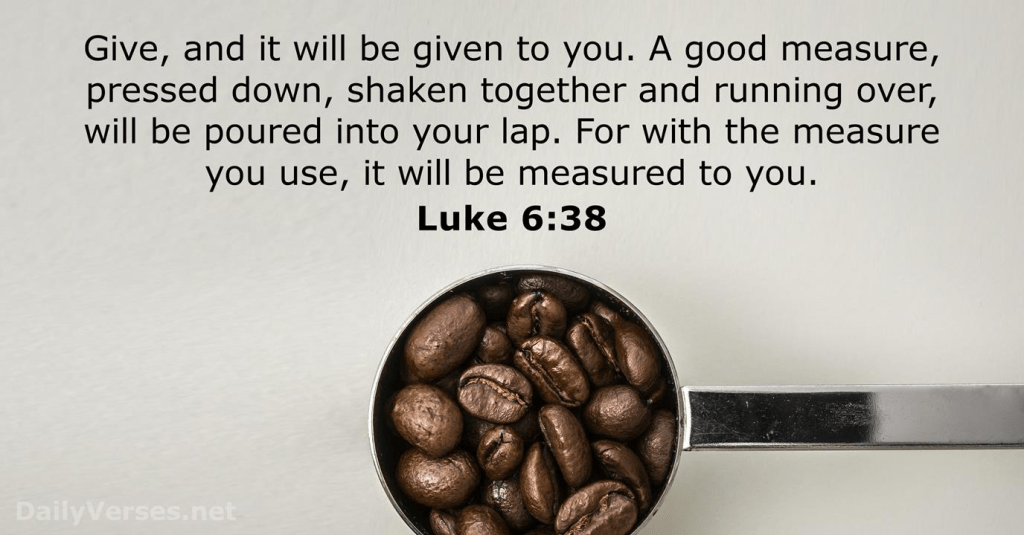
Do not judge others, and God will not judge you; do not condemn others, and God will not condemn you; forgive others, and God will forgive you. Give to others, and God will give to you. Indeed, you will receive a full measure, a generous helping, poured into your hands – all that you can hold. The measure you use for others is the one that God will use for you.
Sunday Sermon
In general, life is not fair. Many kind people have terrible lives, and many terrible people have great lives. Americans have an average life expectancy of 79 (men 76, women 81); in Chad, it’s 53. In Monaco, it’s 87. In Monaco, the people eat a Mediterranean diet and have an excellent health care system. Chad has a high rate of infectious diseases combined with poverty and a poor health care system.
I’ve been thinking a lot about the unfairness of life this week while reflecting on U.M. Army. One woman is taking care of her mother, who has extreme dementia, but she has no help, including from her siblings, who live close but seldom visit. Another had a brilliant career in the arts before being sidelined by neurological difficulties. Another is confined to a motorized wheelchair. Two sisters are trying to raise foster children despite having few resources of their own. We visited the Cafe at Mount Calvary Church, where we met people who were living on the streets, failed by the system, because many of them had jobs but couldn’t even afford an apartment.
A few years ago, I was dating someone who came from a lower socioeconomic level. She would do things I had forgotten, like use coupons and shop for the best deal and look for free entertainment like parks and community concerts. When we drove around and she saw a person on the side of the road with a sign, she would pull over, get out of the car and talk to the person. She called me one time because oranges were on sale and was surprised that I wasn’t excited. I realized that I no longer knew what oranges cost, because when I want oranges, I just buy them. For me, this was a whole different world, and it was extremely humbling.
Where is this world? Last week the kids were in the car and we were driving from Northport to Huntington. As soon as we passed New York Avenue, the roads got worse and the people looked poorer. One of the kids asked, “How are these neighborhoods right next to each other?” But there are also pockets of this world everywhere: places where people are just trying to get by, and nobody knows what they are going through.
Life is often unfair. One person can work hard all their life and get nowhere, while another barely tries and succeeds. One person can eat right and exercise and still get cancer or be hit by a car, while another can drink and smoke and somehow stay healthy. There’s no predicting what can happen. Many people, mistakenly assuming that life should be fair, blame the discrepancies on God. But while life is unfair, God is not.
Today’s Scripture is part of the Sermon on the Mount, Jesus’ introductory speech to the people, most of whom were poor. In this section of the sermon, he offers a clear-cut way to look at life:
Do not judge others, and God will not judge you; do not condemn others, and God will not condemn you; forgive others, and God will forgive you. Give to others, and God will give to you. Indeed, you will receive a full measure, a generous helping, poured into your hands – all that you can hold. The measure you use for others is the one that God will use for you.
I like to understand the rules, which means I have to pay attention. You may have been given a test in elementary school that went like this: #1, Read all the rules. #2. Stand up and salute the flag. #3, Make a chicken noise, and so on. But if you had followed rule #1 and read the whole thing, the last line said, “Don’t do anything after #1.”
The rules should be, “Work hard and you will succeed. Eat well and you will be healthy. The smartest and kindest people will rule the world.” But long before the Sermon on the Mount, Ecclesiastes realized that there was something wrong with such expectations. He writes, “The race is not to the swift or the battle to the strong, nor does food come to the wise or wealth to the brilliant or favor to the learned; but time and chance happen to them all.”
The real rules are revealed by Jesus, and can be summarized in a simple sentence: the way we treat others is the way God will treat us. The people listening had been taught something else: that they deserved their own poverty, due to their sin or their parents’ sin; Jesus wiped this teaching off the board, and replaced it with something completely different.
He gives the people two pairs of options: judge and condemn, or give and forgive. To judge is to make assumptions about the worth of another person and to find them wanting. To condemn is to treat them as less than ourselves. We see this in the news and social media, where entire articles are devoted to a person wearing the wrong outfit or saying the wrong thing. To condemn is to make sweeping assessments which often include a stereotype or a generalization: we confuse countries with their governments and criminals with their nationalities. Once we dehumanize a person, a race or a nation, it becomes easier to judge and condemn.
Jesus offers an alternative: give and forgive. Giving is the easier of the two, because it is an action; but it is preceded by forgiving, which is both a thought and an action. Jesus’ prime teaching on forgiveness comes at the very end, when he says, “Father, forgive them, for they know not what they do.” His sacrifice is the pinnacle of forgiveness. He exits life with no grudges, and encourages us to live the same way.
Has anyone hurt us? Or to paraphrase the words of the law commercial: “Have you been hurt by anyone, anytime, in any way? Call the law offices of Jacoby and Myers!”
I have been hurt by lots of people and lots of things. I could start with elementary school and work my way up. I could blame my ancestors and my bosses and my neighbors and my partners and some of my friends, maybe throw in a couple restaurants and stores and add some airlines and corporations, and that would keep Jacoby and Myers and me busy for a while. But I don’t want to live that way, and Jesus doesn’t want me to live that way either.
Instead, Jesus wants me to forgive. Who does Jesus want me to forgive? Everybody. Why does Jesus want me to forgive everybody? Because it’s literally good for the soul. But also, in a purely transactional way, it increases my own chances of being forgiven. Forgiven for what? What kind of people might be mad at me for something that happened in the past, or is happening now? It’s the same list: some family members and bosses and co-workers and neighbors and some of my friends, maybe even some servers and shop owners because I didn’t tip well or didn’t buy anything or in the case of a restaurant, said I’d be back but totally lied which happened earlier this summer. Anyone I tailgated or cut off, knowingly or unknowingly. It’s a long list.
And Jesus also wants me to be generous, which begins with generosity of thought. The person who hurt my feelings, maybe they were having a bad day. The person who cut me off may have been racing to the hospital because their water broke or their brake lines were cut or they were an undercover cop pursuing a dangerous criminal or all three. The rude check-out person might have other things on their mind, like problems at home or with a relationship or the fact that they resent having a low-paying job, or maybe their back is hurting from standing all day and they don’t have insurance.
Generosity of thought leads to generosity of words, which sometimes means saying a better thing than the thing we were planning on saying and sometimes saying nothing at all. I was at a meeting with the DS this week and he was really happy they had coffee because he said he needed it, and it was clearly making him happier, and I really wanted to tell him that he was drinking decaf and that the real coffee was in the kitchen, but by the grace of God I kept my mouth shut. But the greatest generosity of words is to relate, to compliment, to encourage. It’s easy to tell people what they are doing wrong; it’s better to concentrate on what they are doing right. We’re all familiar with the saying, “If you don’t have anything nice to say, don’t say anything at all.” But the other side of the sentiment is “If you do have something nice to say, anything at all, for God’s sake, say it!”
Even better is generosity of deed: to help in a palpable way. Sometimes this is being a good neighbor; other times it’s volunteering or donating. I was super proud of my friend’s teenager the other day because the volleyball group had to dig up the net and move it 100 feet further from the water. He jumped up and said, “What can I do to help?” And of course every person at UM Army made me proud, because they were eager to do even the smallest things to help others in need.
If we’re stingy with our time, our resources and our love, the sentence, “The measure you use for others is the measure that God will use for you” is scary. But if we’re generous, the sentence is comforting, because when we give, we are already receiving “a full measure, a generous helping, poured into our hands, all that we can hold.” The heart feels lighter, God feels closer and life seems fairer. May we be filled with the love that God has already given us and may this fullness make us generous of heart, body, spirit and mind. Amen.
Closing Song: Matt Maher, “Hold Us Together”
Benediction
Let us go forth with eyes wide open,
ears ready to hear and hands ready to help. Amen.
 Centerport United Methodist Church