
Call to Worship (Jacob Trapp)
To worship is to sing with the beauty of the earth,
To listen through a storm to the still, small voice within.
To worship is to be silent, receptive,
Before a tree astir with the wind
Or the passing shadow of a cloud.
Worship is an inarticulate silence learning to speak;
The window of the moment open to the sky of the eternal.
Worship is the mystery within us
Reaching out to the mystery beyond.
Unison Prayer
May we be reminded here of our greatest aspirations, and inspired to share our gifts of love with the people of God. May we remember that we are not isolated beings, but connected, in mystery and miracle, to our creator, to this community of faith, and to each other. Amen.
Words of Assurance: Proverbs 15:33a, Good News Bible
Reverence for the Lord is an education in itself.
The Lord’s Prayer
Our Father, who art in heaven, hallowed be thy name. Thy kingdom come, thy will be done, on earth as it is in heaven. Give us this day our daily bread; and forgive us our trespasses, as we forgive those who trespass against us. And lead us not into temptation, but deliver us from evil; for thine is the kingdom, and the power, and the glory forever. Amen.
Opening Song: Jordan St. Cyr, “Weary Traveler”
Scripture Lesson: Numbers 22:21-33, NIV
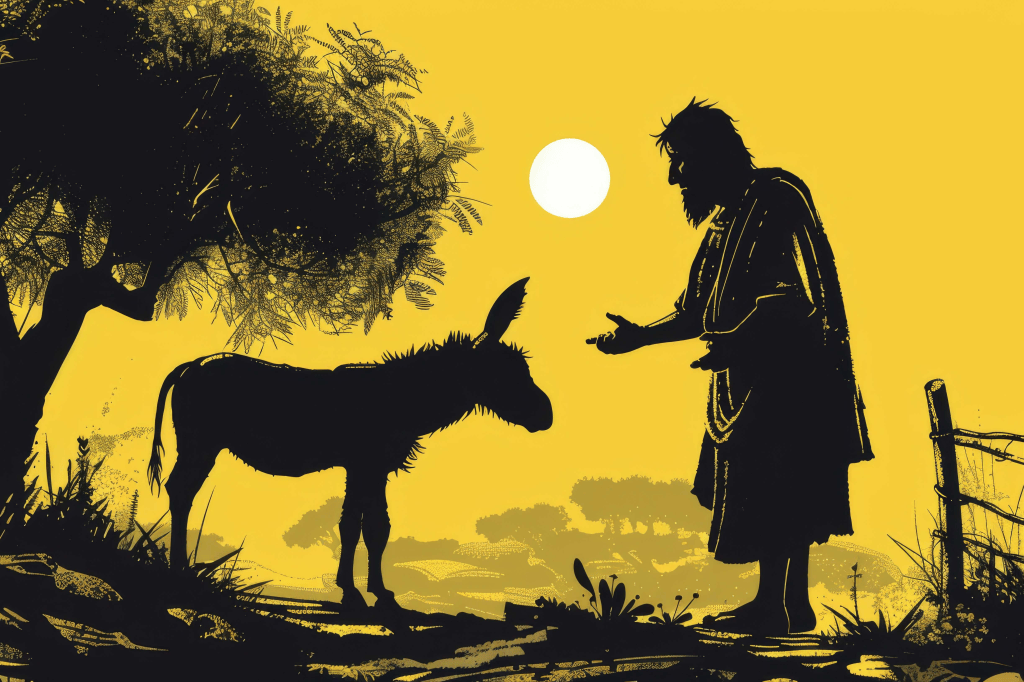
Balaam got up in the morning, saddled his donkey and went with the Moabite officials. But God was very angry when he went, and the angel of the Lord stood in the road to oppose him. Balaam was riding on his donkey, and his two servants were with him. When the donkey saw the angel of the Lord standing in the road with a drawn sword in his hand, it turned off the road into a field. Balaam beat it to get it back on the road.
Then the angel of the Lord stood in a narrow path through the vineyards, with walls on both sides. When the donkey saw the angel of the Lord, it pressed close to the wall, crushing Balaam’s foot against it. So he beat the donkey again.
Then the angel of the Lord moved on ahead and stood in a narrow place where there was no room to turn, either to the right or to the left. When the donkey saw the angel of the Lord, it lay down under Balaam, and he was angry and beat it with his staff. Then the Lord opened the donkey’s mouth, and it said to Balaam, “What have I done to you to make you beat me these three times?”
Balaam answered the donkey, “You have made a fool of me! If only I had a sword in my hand, I would kill you right now.”
The donkey said to Balaam, “Am I not your own donkey, which you have always ridden, to this day? Have I been in the habit of doing this to you?”
“No,” he said.
Then the Lord opened Balaam’s eyes, and he saw the angel of the Lord standing in the road with his sword drawn. So he bowed low and fell facedown.
The angel of the Lord asked him, “Why have you beaten your donkey these three times? I have come here to oppose you because your path is a reckless one before me. The donkey saw me and turned away from me these three times. If it had not turned away, I would certainly have killed you by now, but I would have spared it.”
Sunday Sermon: “Donkey Lessons”
Men are notoriously bad at asking directions. We can be so overconfident that we ignore maps and rely on our own instincts. This is almost always wrong.
When I was a teenager at a Christian camp in Connecticut, I took a walk in the woods with another kid. We saw markings on the trees but decided to ignore them because we saw more interesting things off the trail, and of course we got lost – really lost. We ran into some other people and asked where we were and they said “Massachusetts.” (We didn’t know that we were only a mile into Massachusetts so we thought we’d walked across an entire state.). When the sun started to set we knew we were in trouble. I remembered something about following a river so we did that. Eventually we found the markings on the trees again. While we were walking, two different groups of people came up to us and asked us if we’d seen any lost children, and we were like “No, that’s horrible, we hope you find them!” (Worst search parties ever!) When we got back to camp, we realized that they had been searching for us.
King David writes, “Show me the right path; point out the right road for me to follow” (Psalm 25:4). One of the most basic human questions is “Which way should I go?” But what if we receive an answer we don’t like? God points out the path, and we can follow the directions or we can ignore them. Balaam chooses to ignore them.
The king, who is named Balak, calls for the prophet Balaam and asks him to put a curse on the Israelites. Balaam knows this is probably not a good idea, but he double-checks with God anyway. God tells him, “Do not go with them, and do not curse them, because Israel has my blessing.” That’s pretty clear. But then the king offers Balaam a lot of money, and Balaam is like, “Hold on, let me check with God again.” And this time, God’s response is basically, “Go ahead if you want to. Your call.” And this should make Balaam pause, but it doesn’t.
Balaam is trying to have it both ways. He sets out on the main road, which is the wrong path, fooling himself by thinking that God has given him permission when God has instead given him free will.
In general, we know what’s good for us and what isn’t. We know what’s right and what’s wrong. But sometimes we put God on mute so we can do what we want to. It can be as simple as withholding forgiveness and as complex as working for a corrupt company so we can feed our family. We may know the right path, but there are extenuating circumstances. In the words of James Moore, “Yes, Lord, I have sinned, but I have several excellent excuses.” Balaam’s excuse is money. God wouldn’t want his prophet to be poor, would he? Of course not!
How do we know when it’s God speaking with us? When we pray about what we should do, and God agrees with us, it may or may not be God; it’s hard to tell. But when God disagrees with us, there’s a much better chance that it’s God. Balaam doesn’t get the answer he wants, so he keeps praying until he gets the answer he does. Unfortunately, as he will soon learn, this is not the way prayer works.
Balaam sets out on his donkey, but God sends an angel to stop him. The donkey sees the angel, but Balaam doesn’t. The donkey goes off the road into a field, and Balaam beats the donkey. Stupid donkey! Then the donkey goes down an alley and crushes Balaam’s foot, and he beats the donkey again. Then the donkey has nowhere to go except toward the angel, who has a flaming sword, so he just lies down, and Balaam goes ballistic.
Donkey Lesson #1: Sometimes to save people’s lives, we have to act like donkeys. Donkey Lesson #2: Sometimes the people we think are donkeys are really our friends.
When we see someone we love headed down the wrong path, we have an obligation to tell them, even if telling them means that we’re going to be abused. They might not appreciate our insight. They might not see that we’re trying to help. They might get defensive. We might be saying, “You have to stop drinking” or “You can’t be cheating on your spouse” or “I don’t like the person you’ve become.” I once broke up with a single mom who had a habit of swearing at her 2-year-old daughter. She told me it was “none of my business.” I said, “You’re right, but I can’t watch this.”
Tough love sometimes means saying no, or even saying goodbye. It can draw verbal abuse. It usually hurts the one doing the loving.
God gives the donkey the gift of speech, and the donkey asks, “What have I done to you? Why have you beaten me three times?” Balaam answers, “Because you made a fool of me! If I had a sword, I would kill you!“
Balaam is so far gone, he doesn’t even notice that the donkey is talking. The donkey is trying to save his life while he is threatening to kill the donkey. The donkey is the only one doing the right thing, but is receiving no credit. “Haven’t I been a good donkey?” he asks. “Have I ever treated you this way before?”
Balaam might not have a sword, but the angel does. And God opens his eyes to see the angel. And the angel asks, “Why have you beaten your donkey? You are on the wrong path, and your donkey was trying to save you. If your donkey hadn’t turned away, I would have killed you by now, but I would have spared him.“
This is, by the way, the best moment of the donkey’s life. You can totally picture him doing a donkey dance, because he has been vindicated.
God is with us when we do the right thing. God defends. God rewards. After this, Balaam gets back on the right path. He blesses the Israelites instead of cursing them. He doesn’t get paid in money, but gets paid with a longer life. The king gets mad, but what is a king compared to God?
This is the story of a man who acted like a donkey, and a donkey who acted like a man. Donkey Lesson #3: If someone in your life is acting like a donkey, ask yourself, “Could God have sent them?” Donkey Lesson #4: If God asks you to be a donkey, be a donkey. The angels will be on your side. Amen.
Closing Song: Rend Collective, “Life Is Beautiful”

